
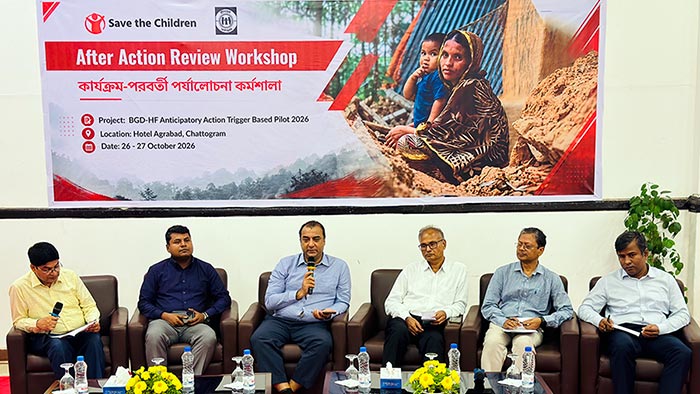
Government officials and disaster management stakeholders have emphasized the importance of strengthening early warning dissemination, identifying vulnerable communities, and enhancing coordination with local authorities to minimize casualties and damage through timely and effective anticipatory actions following disaster forecasts. They stressed that disaster risk management should move beyond reliance on immediate relief operations and focus on institutionalizing forecast-based anticipatory action to reduce the potential impacts of disasters.
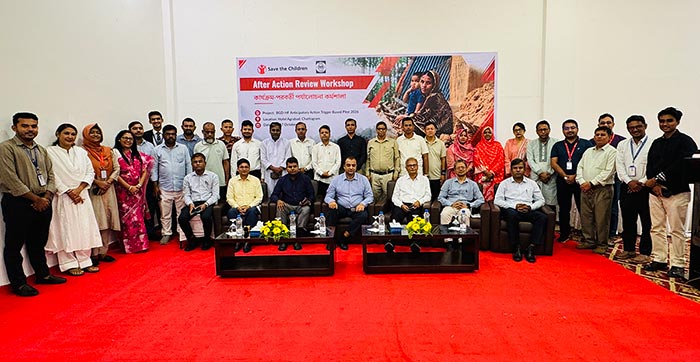
These observations were made during an After Action Review (AAR) Workshop held on 26 October, at Ichamati Hall, Hotel Agrabad, Chattogram. The workshop was organized by YPSA, with support from Save the Children, under the project titled “BGD HF – Anticipatory Action Trigger Based Pilot – 2026.”
The event brought together government officials, disaster management experts, meteorologists, representatives of local administration, elected representatives, and implementing partner organizations.
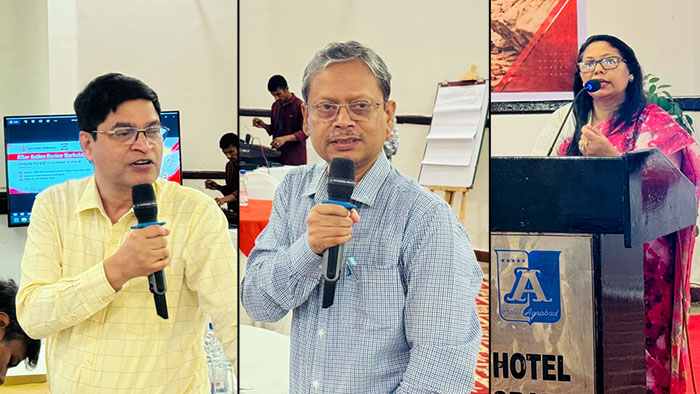
Discussions focused on evaluating the effectiveness of anticipatory actions undertaken in Banshkhali, Chattogram, in August 2026 to address landslide risks, identifying key achievements and challenges, and exploring ways to improve future interventions.
The workshop featured a panel discussion attended by Md. Ashraful Amin, Acting Chief Executive Officer of Chattogram City Corporation; Badiuzzaman, Deputy Secretary, Ministry of Disaster Management and Relief; Md. Abdul Awal, Senior Assistant Secretary; Md. Ruhul Amin, Upazila Nirbahi Officer (UNO), Banshkhali; and Kamrul Hasan, Meteorologist, Bangladesh Meteorological Department (BMD).The panel discussion was moderated by Dr. Abul Kalam Mallik, Meteorologist.
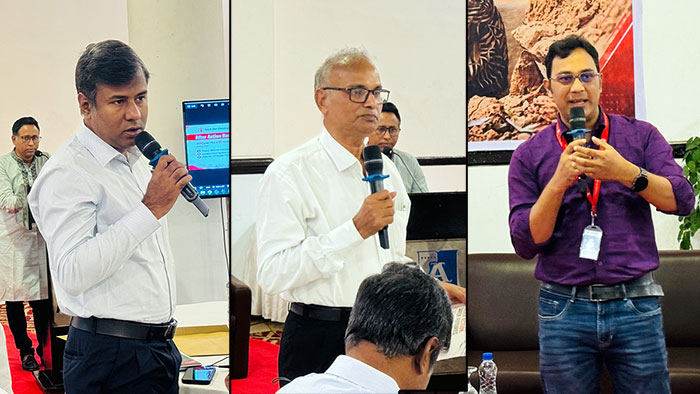
Other distinguished participants included Masudur Rahman, District Relief and Rehabilitation Officer, Chattogram; Debabrata, Assistant Commissioner (Land), Agrabad; and representatives from the Department of Agricultural Extension, Forest Department, and Fire Service and Civil Defence.
Cash Assistance Provided to 420 Families Based on Disaster Forecasts
At the beginning of the workshop, Nasim Banu, Director (Social Development), YPSA, presented an overview of the project’s activities, achievements, challenges, and lessons learned.She stated that anticipatory actions were initiated in Banshkhali following landslide risk forecasts and information issued by the Bangladesh Meteorological Department (BMD) and the Regional Integrated Multi-Hazard Early Warning System (RIMES) on 17 August 2026.
Under the initiative, 420 vulnerable households across four unions of Banshkhali received unconditional cash assistance of BDT 6,000 per household to strengthen their preparedness against potential landslide impacts.She explained that the primary objective of the intervention was to ensure timely assistance and enable at-risk households to take necessary preparedness measures before a potential disaster. Following the cash distribution, the effectiveness of the intervention and beneficiaries’ experiences were assessed through Post-Distribution Monitoring (PDM), Focus Group Discussions (FGDs), and Key Informant Interviews (KIIs).
Subsequently, Mohsin Kabir, Senior Officer, and Wajiha Faiza, Knowledge Management Officer, Save the Children, delivered presentations highlighting the project’s background, implementation process, and key achievements. A documentary showcasing the project’s activities was also screened during the session.
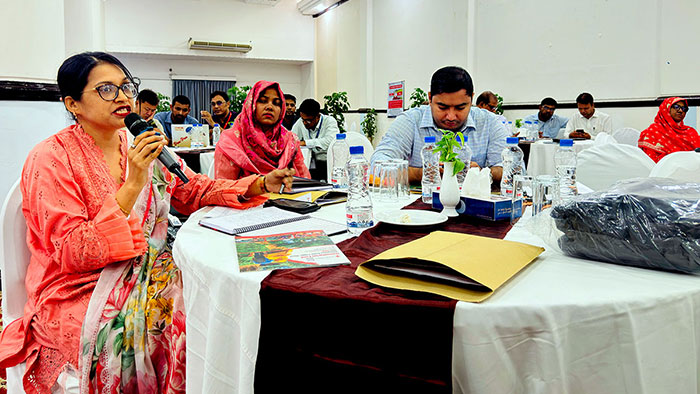
Call for Institutionalizing Anticipatory Action
Speaking at the workshop, Badiuzzaman, Deputy Secretary of the Ministry of Disaster Management and Relief, emphasized the importance of translating early warnings into timely and effective actions. He stated: “To reduce disaster-related losses and damage, it is essential to link early warning information with timely and effective anticipatory measures. This requires reliable forecasts, accurate information on vulnerable populations, and strong coordination between local administration and implementing organizations. Experiences and lessons learned from successful anticipatory action initiatives must be utilized to strengthen preparedness for future disasters.”
He further highlighted that coordinated efforts among government institutions, development partners, and local communities could play a significant role in reducing disaster risks. According to him, review workshops of this nature provide valuable opportunities to identify implementation gaps and determine practical measures for improving future interventions.
Md. Ashraful Amin, Acting Chief Executive Officer of Chattogram City Corporation, emphasized the importance of encouraging residents of landslide-prone settlements in the city’s hilly areas to relocate to safer locations. He also highlighted the need for greater involvement of the City Corporation in such initiatives and increased awareness at the community level.
Md. Ruhul Amin, Upazila Nirbahi Officer of Banshkhali, appreciated YPSA’s efforts and stated that initiatives of this nature could enhance the preparedness and resilience of communities living in disaster-prone areas. He also emphasized the importance of expanding similar interventions in the future to reach more vulnerable populations.
During the discussion, local elected representatives recommended strengthening coordination with Union Parishads in beneficiary selection and cash assistance distribution. They observed that maintaining updated information on vulnerable households and ensuring assistance based on actual community needs would significantly improve the effectiveness of anticipatory action initiatives.
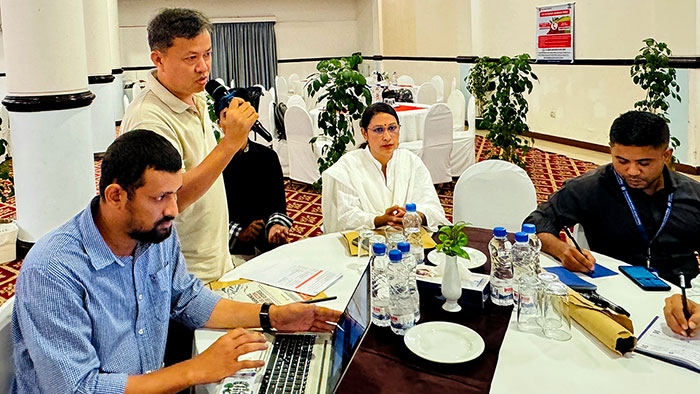
Commitment to Applying Lessons Learned in Future Interventions
Workshop participants shared their observations and recommendations on several critical areas, including the timely dissemination of early warning messages, identification of vulnerable households, appropriate utilization of cash assistance, coordination with local authorities, and strengthening community-level awareness. Participants also reviewed the effectiveness of actions undertaken during the August 2026 intervention, discussed operational challenges, and identified areas requiring improvement in future programming. The workshop aimed to translate practical experiences and lessons learned into more timely, effective, inclusive, and people-centered anticipatory action interventions.
The workshop concluded with closing remarks by Palash Chowdhury, Director (Finance), YPSA. The event was facilitated by Muhammad Ataul Hakim, Project Officer, YPSA.