
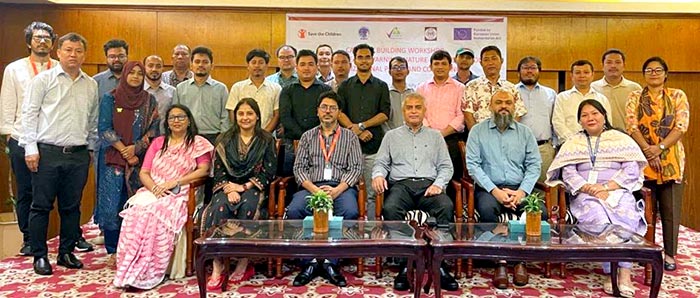
Under the project titled “Scaling Up Multi-Hazard Anticipatory Action in Hilly Regions of Bangladesh (SURAKKHA),” a three-day capacity-building workshop on “Multi-Hazard Early Warning, Nature-based Solutions, and Organizational Policy and Compliance” is being held in Chattogram to strengthen anticipatory action capacity in the hilly regions of Bangladesh.
The workshop is being held from 7–9 September 2026 at Hotel Peninsula, GEC, Chattogram, bringing together project staff from Save the Children Bangladesh, RIMES, YPSA, and ASHIKA Development Associates. The project is funded by the European Civil Protection and Humanitarian Aid Operations (DG ECHO), the SURAKKHA project is implemented by Save the Children Bangladesh in partnership with RIMES, YPSA, and ASHIKA Development Associates across Chattogram, Rangamati, Khagrachhari, and Bandarban.
The SURAKKHA project is being implemented to achieve the overarching result of enhancing the adaptive capacity of communities and institutions to generate, communicate, and act on timely and inclusive early warnings; operationalize child-centered and gender-responsive anticipatory actions; and institutionalize multi-hazard anticipatory action for effective preparedness, response, and sustainable risk reduction in the hilly regions of Bangladesh.
The hilly regions of southeastern Bangladesh face significant exposure to landslides, flash floods, heavy rainfall and other cascading hazards, compounded by complex terrain and remoteness. The workshop is designed to strengthen participants’ technical and operational readiness to anticipate and respond to these risks, while also refining how SURAKKHA translates that knowledge into implementation.
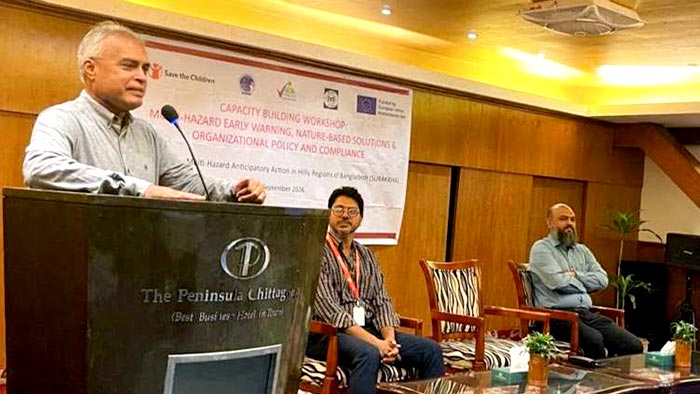
The event was attended by Dr. Md. Arifur Rahman, Founder and Chief Executive of YPSA; Mohammad Saimon Rahman, Senior Manager, Save the Children; Raihanul Haque Khan, Country Lead, RIMES; Fatema Mehernnessa Tania, Manager, Save the Children; Nasim Banu Shyamoli, Director, Social Development Department, YPSA.
In his remarks, Dr. Md. Arifur Rahman said that given the way various disasters are occurring at present, everyone must become more aware of their responsibilities, both as institutions and as individuals, adding that the recent disaster in Nepal has offered important lessons for all. He also highlighted several beneficial aspects of HAM radio in strengthening emergency communication.
The workshop will conclude with participants and partner organizations reaffirming their commitment to strengthening early warning systems, nature-based solutions and coordinated anticipatory action across Chattogram, Rangamati, Khagrachhari and Bandarban. With refreshed technical knowledge and a clearer implementation roadmap, SURAKKHA partners will be better positioned to protect vulnerable communities in Bangladesh’s hilly regions from the growing impacts of climate- and disaster-related hazards.