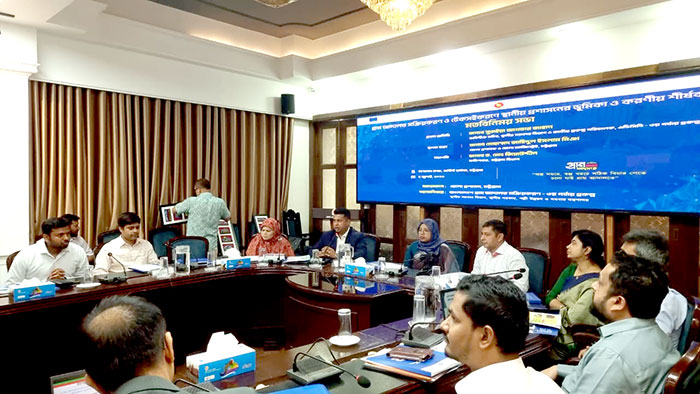
A views-exchange meeting on the role and responsibilities of local administration in activating and sustaining village courts was held in Chattogram.
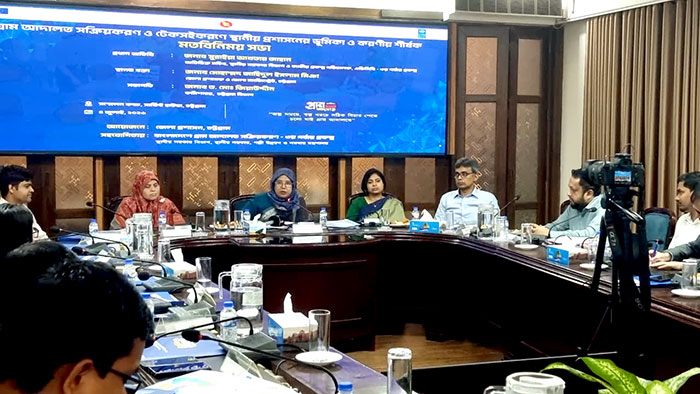
The meeting was organized by the District Administration, Chattogram, with support from the Activating Village Courts in Bangladesh Phase-III Project. It took place at the conference room of Chattogram Circuit House on Saturday.
Ms. Suraiya Akhter Jahan, Additional Secretary of the Local Government Division and National Project Director of the Activating Village Courts in Bangladesh Phase-III Project, attended the event as the chief guest. The meeting was chaired by Dr. Md. Ziauddin, Divisional Commissioner of Chattogram, while Mr. Mohammad Zahidul Islam Mia, Deputy Commissioner and District Magistrate of Chattogram, delivered the welcome speech. The programme was conducted by Mr. Golam Mainuddin Hasan, Deputy Director of Local Government, Chattogram.
Speaking as the chief guest, Ms. Suraiya Akhter Jahan said the main objective of village courts is to resolve family and local-level disputes quickly, easily and at low cost, while maintaining social harmony. She said that if disputes between family members, brothers or neighbours can be settled through village courts, mutual anger and resentment can be reduced, helping to establish lasting peace and order in society.
She said that, under the project’s exit plan, initiatives have been taken to strengthen awareness campaigns through inter-ministerial coordination. Village courts are also an important platform for increasing public trust in Union Parishad chairmen. Therefore, chairmen must play a more active and responsible role in making village courts effective.
She further mentioned that Upazila Nirbahi Officers will regularly observe village court hearings as part of monitoring activities. At the field level, beat police will also play a supportive role in supervising village court activities. She added that the government has a plan to introduce a separate budget code for village courts in order to make the system more institutionalized. Village court performance has also been included in government performance appraisal.
Ms. Jahan said that after the local government elections, special training on village courts will be arranged for newly elected public representatives under the initiative of the Upazila Nirbahi Officers. She also emphasized the importance of ensuring the representation of women, minorities and marginalized communities in the village court process.
In his speech as chair, Chattogram Divisional Commissioner Dr. Md. Ziauddin said that public understanding of village courts is still not clear enough. Therefore, necessary infrastructure and a suitable environment should be ensured in every Union Parishad to make village court activities more effective.
He said village courts can play an important role in maintaining peace and discipline in rural areas by utilizing the positive aspects of the traditional village panchayat system. He also noted that the government is giving special importance to village courts to reduce the pressure of cases on higher courts.
Dr. Ziauddin suggested considering whether a specific dress code or identity mark could be introduced for those conducting village court proceedings. He also proposed that a checklist could be maintained at UNO offices before disputes are taken to higher courts.
In his welcome speech, Deputy Commissioner and District Magistrate Mohammad Zahidul Islam Mia said the government has long been working to strengthen village court activities. Although the social and institutional structure of villages has changed over time, the importance of village courts has not decreased. Rather, village courts remain highly significant in ensuring easy, quick and low-cost access to justice for marginalized people.
He said the government’s vision of a humane Bangladesh can only be realized when the right to justice for marginalized communities is ensured. The government considers village courts as an important indicator of good governance and justice at the local level. He urged district and upazila administrations to work with greater sincerity to make village court activities more active and effective.
He added that people should not be forced to go to distant courts for minor disputes. Public trust in village courts must be built at the union level, and people should be encouraged to receive services from village courts. Only then will this initiative bring real benefits to the country.
The Deputy Commissioner also said that one major difference between developed countries and Bangladesh is that institutions are stronger in developed countries, while in Bangladesh individuals often become more powerful than institutions. To build a just and sustainable state system, dependence on individuals must be reduced and institutions must be strengthened. Village courts are an important part of that institutional strengthening process.
The keynote paper was presented by Mr. Golam Mainuddin Hasan, Deputy Director of Local Government, Chattogram.
Among others, Manowara Begum, Director of Local Government Division; Roksana Khan, Joint Secretary; Dr. Shahed Mostafa, Deputy Secretary, Law-1; Subrata Dash, District Legal Aid Officer and Senior Assistant Judge, Chattogram; Mohammad Omar Faruk, Deputy Director of the Department of Social Services; Mohammad Abul Bashar, Deputy Director of the Department of Youth Development; Upazila Nirbahi Officers from all upazilas of Chattogram; Shaheen Akhter, Regional Director of Bangladesh Betar; Nasim Banu, Director, Social Development of YPSA, the implementing partner organization of the village courts project; religious representatives, youth representatives, and district and upazila-level officials of the village court project were present at the meeting.